Hiển thị các bài đăng có nhãn Antarctica. Hiển thị tất cả bài đăng

Thứ Ba, 16 tháng 3, 2010

What’s Green In Antarctica?


One of nature’s little quirks sees the world’s most southerly continent Antarctica, classified as a desert. Wikipedia states: “This polar desert is planet earth’s largest, coldest and driest region.” If this fact isn’t in Ripley’s Believe It Or Not, then it should be.

Heading southwards to Antarctica in the summer of 2008, visions of whiteness, glaciers and penguins danced before my eyes….not green.

So what is green down below?

Plants

Greenery in Antarctica

Circa back around 85 million years and you could have been picking flowers way down south around the Antarctic Circle. Today, in the 21st century, for an up close with lichens take a look at Heard Island. This largest sub Antarctic island has no human introduced plants and you could, (if it was allowed that was,) brighten up your vase with around 12 species of flowering plants.

What’s more, swap your plant vase for a fossil basket and marvel at ancient plant forms.
The Antarctic Peninsula and Transantarctic mountains yield the most common fossil wood finds and the oldest microbes ever found are recent discoveries of DNA and bacteria dated at around 8 million years.

Katabatic winds (also termed descending winds) and blizzards race off the Antarctic Plateau at up to 100 miles per hour. This unique phenomenon discourages growth of anything larger than “knee high to a grasshopper”. Our current civilization’s version of going green Antarctic style sees the main stayers being lichens, mosses and algae.

Ice Runways

Wilkins new ice runway, with no trees for navigation

Perhaps the strangest example of plant growth was in 1957 when 24 pine trees were re located from New Zealand and planted alongside ‘Willy Field’, McMurdo Sound’s landing strip. The Air Force modus operandi of marking ice runways in the Northern hemisphere wouldn’t get off the ground down south today with environmental protocol protected under the Antarctic treaty.

February 2008 saw the opening of the latest glacial blue ice runway, the 2.5-mile long Australian Wilkins runway. Modern technology now sees the sides of the runway marked with precision approach path indicators. In light of environmental issues, these are definitely more preferable than pine trees.

Antarctic Hothouses

Arctowski Polish Research Station

Over 40 scientific bases are spread over this huge continent and a literal growth industry has been the implementation of hothouses to provide the fresh food component of their daily diet. On the menu is a veritable farmers market of vegetables and herbs.

One highlight of the winter over season is the humble tomato. Inter base rivalry sees their tomato seeds planted May 1st, with the largest or weirdest shaped tomato grown in 3 months winning the competition. What a great way to fill in leisure time, as you not only get to enjoy the fruits of your labor, you also get to lord it over the other competing research stations.

Antarctic hothouse produce is grown hydroponically. No possible biological invasion via soil is allowed. Apart from the unique challenge of growing food in this hostile environment, certain something not found elsewhere in the world is that Antarctic home grown flavour.

Green Energy

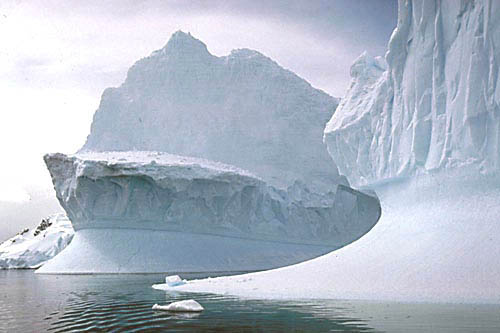
Icebergs in the mist

Wind harvesting is the way to go in Antarctica. Type ‘wind energy Antarctica’ into Google and get off track reading about NASA scientists who are excited about using similar hybrid wind and solar prototypes on the planet Mars.

Efficient energy is the key word for both habitats, and Antarctica has been developing wind turbines in an environment that has seen wind speeds topping 155 miles per hour. Antarctica’s harshness has previously deterred the use of wind turbines, but modern technology combined with cooperative expertise from various treaty countries has seen advancement in the field and reality has finally caught up with the dream.

The latest example is the world’s first zero emission Antarctic research station. Belgium-built “Princes Elisabeth” was up and running for the 2008 summer season. Solar panels and 8 wind turbines are the core energy sources and sustainability is the catch-word for the future when it comes to the reality of satisfying the world’s rapidly growing clean energy needs. Kinetic energy here we come.

But let’s not stop there. Take this clean power solution one step further as we visualize a future where Antarctica will eventually have an electricity surplus, which could be exported via super-conductive undersea electric power cables to South America and beyond.

If our new energy technology is OK for Mars, I guess it’s OK for South America and the rest of us “Earthlings”.

Penguins

Ice-skating penguins

Wiki.answers.com lists 18 species of penguins worldwide, and the Antarctic continent
is the home ground where 4 species breed.

Adelie penguins have white around their eyes giving a constant surprised look, while the Chinstrap’s markings add a certain something to their black & white suits.

The Gentoo family follows the nesting norm, Antarctic style and gathers small pebbles into a circle nest. Stone envy is not uncommon in these environs and stealing is a common problem that sees neighborhood fights on a regular basis during the breeding season.

The unforgettable Emperor Penguin, star of the hit movie ‘Happy Feet’, holds the title of the world’s largest penguin. He also has the longest walk of all, up to 75 miles to court and breed during the Antarctic winter season on this amazing continent. What has been termed ‘The Biggest Crèche in the World’ sees around 25,000 Emperor Penguins herding their young into huddles to conserve warmth and save them from freezing to death.

NB: My up close and personal green encounter with frozen algae on Petermann Island wasn’t that dramatic, just my downfall. One fractured coccyx later saw me envying the young penguins as they learnt to ice skate on their slice of green Antarctica.

I wouldn’t change anything about this amazing and precious part of our world. Let’s hope Antarctica stays as green as she is, tourism, scientists, technology and Mars notwithstanding.


Source: bootsnall.com

The Coldest Places on Every Continent

Think winter sucks this year around your particular patch of ice? Stop sniffling, it could be worse. Every continent has places where cold takes on a whole new meaning. Here are some of the places where winter is more than just a few dark days. Pry the ice out of those tear ducts and have a look.

North America

Mayor Hannah Stauts evidently likes the cold

If you’re not in Stanley, Idaho, right now you have no reason to complain. If you are, and you’re reading this, by all means, both of you, continue complaining.

Stanley, named for the god of tongues sticking to metal, reports the coldest temperature in the lower 48 states some 300+ days each year. Near Sun Valley, but without a ritzy ski resort, Stanley is an outdoor recreation winter wonderland with 100 residents and a mayor still trying to figure out what she wants to be when she grows up. Mayor Hannah Stauts, 23, entered the record books as the youngest female mayor in the US and bears more than a passing resemblance to both Hannah Montana and Darryl Hannah.

South America

Mt. Cayambe proves the equator isn't all that hot
Mt. Cayambe proves the equator isn’t all that hot

The coldest place in South America? You’d think it would be Chile. But it seems that some parts of the world are not obsessed with recording their weather. Comprehensive data and information exists for almost every corner of the world, but Chile seems to me to be a little bit lax in their record-keeping. It’s nothing that I can prove, it’s just that I don’t quite trust that the record low of -27.4 F in Sarmiento, Argentina back in 1907 is actually the coldest it has ever been in South America.

You might as well argue that Patagonia is the coldest place in South America because it spawned a clothing company renowned for warm clothes. No one can prove you wrong.

One thing we do know though, Mt Cayambe, near Quito, Ecuador is the most interesting cold place in South America, it has a daytime average of 2 degrees celsius and an overnight average of -10 C and lies almost directly on the equator.

Africa

This, believe it or not, is Morocco

If you are like most people, you may have been under the impression that Sutherland was the coldest place in South Africa. You would be mistaken, that distinction goes instead to Buffelsfontein.

In what may be the most meaningless dispute in meteorology, numerous sources still list Sutherland as the coldest place despite the fact that it has a mean annual winter temperature of -3.8 degrees C while Sutherland’s mean winter month temperature is the relatively tropical -1.2 C.

In other surprising news, the coldest temperature ever recorded in Africa is not at the latitudinal extreme of South Africa, but, counter intuitively, in the northern climes of Morocco, at the mountain town of Ifrane where the mercury reached -11 F.

Russia

Verkhoyansk, Russia - Stalin's Death Ring
Verkhoyansk, Russia – Stalin’s Death Ring

Russia gets its own section here, because it happens to contain the coldest place in both Europe and Asia. So let us revel in the mind boggling cold that mothered the invention of Vodka, stopped Hitler’s forces and makes Mongolia look reasonable.

Verkhoyansk, Russia is considered the coldest place in Asia, with a measured record temperature of -90 degrees F and an average (average!) of -50 F and an all-time high of -17 in the month of January. This qualifies it for a subarctic climate and gave the region the WWE-worthy name Stalin’s Death Ring and the Pole of Cold. 1,400 people call it home.

The coldest place in Europe is Ust-Shchugor, Russia, which lets Finland and Sweden have all of the moderate weather before taking the brunt of the arctic systems. Still, it does not compare with Verkhoyansk, Ust-Shchugor’s best effort in the record contest is an almost habitable -72.6 F. But friends don’t let friends live in Ust-Shchugor.

Antarctica

Cold is redefined at the Vostok Station

Determining the coldest point in Antarctica is a bit like looking for the wettest part of Atlantis. You’re kidding yourself if you think you’ve found it. But since they’ve been keeping records, Vostok, a scientific station in the Southern Pole of Inaccessibility (seriously) has seen the coldest temperature anywhere anyone has brought a thermometer. It’s nearly twice as cold as Russia, it’s so cold that if you through a pot of boiling water in the air, it comes down as ice. It’s -128 F.

The research station’s location, near the South Geomagnetic Pole puts it in a prime spot to observe the Earth’s magnetic sphere and a colossally bad spot to do anything else. Researchers at Vostok experience a near-complete lack of moisture in the air, lack of oxygen due to elevation, lack of carbon dioxide, which monkeys with your breathing mechanism, and three months each winter without sun.

Australia

Sometimes Charlotte Pass, Australia can be brutal

If you really want to escape the cold, though Australia is the place to start. Even at its worst, at Charlotte Pass on May 29, 1994, temperatures only dropped to -9.4 F. Cold enough to curl your toes and tickle your nose, but it hardly seems worthy of the record books. The Snowbird Lodge is among the many fine ski resorts in the area.

New Zealand is even balmier, with a record low of -6.9 F on July 3 1995 in the town of Ophir. This may not, in fact, be quite as cold as where you live, so as of now, you have permission to resume complaining.


Source: bootsnall.com

On Going South – Antarctica, Argentina


"What? You've been to the South Pole?"

Unfortunately I haven't, but this question is frequently asked when someone looks at a map showing my various journeys. I have, however, done something that surprisingly few seem able to tell apart from a visit to the actual South Pole. I visited the Antarctic Peninsula, the thin finger of land stretching up from Antarctica towards South America.

All that separates the two continents is an inch or so of water, on a typical globe. In real life, this inch consists of an astounding number of actual inches; as you try to cross it by boat, this becomes disturbingly evident.

The bottom of the world

On a backpacker trip through South America, I eventually reached Ushuaia. It's the southern-most town in Argentina, yet it looks just like the coastal village in northern Norway where I spent my childhood. The harbour is full of fishing boats. From a distance the small and cozy homes look like a quilt of many colours. Surrounding the town inland is a wreath of dramatic mountains with snow and ice on top of them, and to the south of the island, a mighty ocean lurks.

It's easy to spend a few days in and around Ushuaia. Hike in the mountains or walk along the Beagle Channel. Feel the history of the island Tierra del Fuego, Fireland, and imagine what it was like to arrive there for the first global circumnavigators, not that long ago, really. You can catch sizable salmon in the rivers, visit an Argentinian estancia/ranch, or you can explore the streets in the town at the end of the world. Or "The bottom of the world", as they somewhat unfortunately tend to call it. Round off your days at a restaurant, enjoying passionate tango and the largest, most tender steaks in the world.

The greatest thing to do in Ushuaia though, is to get on a boat and cross the Southern Seas to reach Antarctica. How far south you go depends on which vessel you travel in and when you go. A number of large cruise ships do Antarctica trips from Ushuaia, but for safety reasons, they stay clear of the ice. Hence they usually only visit islands, not the actual Antarctic mainland. On the other side of the scale, you can go with robust, Russian icebreakers. At the end of the summer they easily make their way well past the Antarctic Circle at roughly 66.5 degrees south.

In Ushuaia I was lucky to be offered an inexpensive last minute ticket to Antarctica. I was to travel with M/V Mariya Yermalova, a fairly basic Russian ship with a strengthened hull, designed to handle iceberg encounters reasonably well. It was the perfect size, with room for about a hundred passengers. IAATO, the International Association of Antarctica Tour Operators, regulates Antarctic tourism. A rule is that no vessel can put more than a hundred people on shore simultaneously. This way the penguins will always outnumber the people on any beach, which is good. More importantly, this meant I would get a lot of time on land.

A crew of fifty and the ship's doctor spoke Russian fluently. In English, however, all they could say was "I hope no problem". Fortunately we also had twelve English-speaking experts on polar matters on board, ready to tell us everything we needed to know.

Among the passengers there were also many interesting personalities. Unique destinations tend to attract unique people. The variety was still large, with more than twenty different nationalities represented. They spanned from the filthy rich with insanely expensive cameras and clothes, to backpackers wearing the same rags they had started out with thousands of miles away. One of them asked whether there was a discount if he slept in the lifeboats instead of a cabin. Slightly worrying, the purser told him, "That will cost extra". I hoped it was a joke.

Our journey began with a lifeboat practice and a wonderful dinner, before we started getting to know each other. Many of us were excited and maybe even a little bit tense, as we knew so little about what was in store for us. The Japanese crowd immediately started writing postcards, while the Israelis mysteriously disappeared. Maybe they went below deck to search for their Promised Cabin. I stayed up for a while, but when the captain turned up in the bar with a wide smile on his face, I decided to go to bed.

While the ship had seemed to be the perfect size, in theory, I wished for a bigger boat when we reached the open sea. The stretch of water between the continents is officially called the Drake Passage, after English privateer Sir Francis Drake (who never actually went there). When you're there, though, you'll just know it as the Drake Shake.

When I went to sleep, we were still close to land, the water was calm. I fell asleep to the sound of creaking boards and orders to the crew being barked over the intercom, in Russian. It was like being in a James Bond movie. I slipped into a dream full of dangerous missions and incredibly friendly females in various supporting roles.

At four in the morning someone violently shook me out of sleep. But I was alone in my bed. More specifically, there were definitely no bikini-clad supermodels around. I realized that we had reached the open sea. A seasickness pill brought me back to slumber.

At six I woke up again. The until then silent Japanese in the upper bunk crashed onto the floor like a kamikaze sleepwalker. He landed on all the stuff that had been on our bedside stands the evening before. "I am trouble!", he groaned, and bravely climbed up into his bed again.

Soup plate overload
Soup plate overload

At 7:30 I did not have breakfast. Others tried, but gave up when milk, coffee and cereal floated around on the floor to the degree that people started getting wet feet. Some managed to make their way back to their beds, while others could not do anything but lie down where they were. Lunch later in the day consisted of tomato soup served in cups. The waves now made soup plates useless. How they even managed to make the soup is something I can only speculate about.

Throughout the day lectures were given to a tiny audience. What impressed the attendees the most was not the quality of the presentations, but that the lecturers managed to remain standing while they spoke. "Bring a pillow, a cover and a seasickness bag, come and learn about the albatross", the loudspeakers enthused. I now slept on the floor.

For two days we struggled across the ocean, making around eight knots on average. When you have a thousand kilometres of mayhem to cover, that is depressingly slow. I stayed in bed, which turned out to be just my size. I could "stand" steadily on the lower end of the bed while using my hands to hold onto the bedposts on each side of my head. This way I avoided being slung out of bed as the ship was thrown this way and that by giant waves. This effort demanded enough of my concentration to allow me to forget seasickness.

It was still slightly discomforting, especially when the room maids visited. Obviously more used to life at sea than me, they did some dusting and tidying up, looked at me and said "Zorry to yoo". I was sort of fascinated by the situation. Trapped in my bed I could do nothing but listen to the stream of messages to the crew. I understood parts of what was said. One of the messages was "Zbigniew machinistr *mumble mumble* schdavodch KAPUT!", and there was some frantic discussion going on in the background.

I had been puzzled by something a polar explorer said in an interview she gave before one of her trips to Antarctica. When asked about what she dreaded the most about the strenuous expedition ahead of her, she answered, "The boat ride home, of course".

Now I understand.


Source: bootsnall.com

Adventures in Antarctica


Years ago, I decided I wanted to make it to every continent before I turned thirty. I backpacked around Europe with a side trip to Morocco, worked for Habitat for Humanity in Thailand, hit the high points in Peru, and woofed it in Australia. By the age of twenty nine, I had one destination left on my list. It was the most remote, most difficult continent to visit on our vast planet – Antarctica.

I had heard stories from other travelers about the cruises they had taken, spending a month or so cruising around the continent. My roommate in Thailand even spent a year working in Antarctica. I, personally, hate the cold and had no plans to invest a whole year of my life that far south, especially when there are so many other great places to visit around the globe. For my trip to the great white continent, I wanted more of an "in and out" plan. And that's what I found, an eight-day cruise aboard the Marco Polo Cruise Ship.

Back home in the United States, I do have a job, which often puts a damper on my travel plans. Because I had some difficulties reconciling my work schedule with my fun schedule, I booked the trip at the last minute. Often, I take off at the drop of the hat, so I was somewhat prepared for the obligatory transportation hiccups that occurred – like the Aerolineas Argentinas strike in Buenos Aires the day I was scheduled to fly from that city to Ushuaia. Even though I booked my flight from EZE, the international airport in Buenos Aires, it actually departed from the Aeroparque, AEP, the domestic airport 45 minutes away. Yes, I missed my flight and was placed on standby for the next and yes, I made my standby flight, but my bags did not. However, I made it to the Antarctica Hostel in the southernmost city in the world about five hours after schedule, which worked for me. And what a hostel it was!

Antarctica Hostel reminded me of everything I love and hate about hostels. Within five minutes, I had dinner plans, and within 30, I had met a whole group of new travelers to swap stories with. The people were fantastic. They were also loud, but not as loud as the roosters. I don't know if roosters crow all over Latin America at the crack of dawn, or if they only do so directly under my hostel windows, but they're a big problem when it gets light at 4:00 a.m. in the Fuegian summer time.

Pool bar
Pool bar

We were to embark at 3:00 p.m. that day, five hours before our scheduled departure. This was my first cruise, and I was interested to find that it would take that long to walk on to a boat. Here I was thinking that arriving at the airport two hours early was bad. I reached the cruise ship dock, with my backpack on my back and my daypack on my front. I don't suppose I looked like the standard passenger, pack in tow and not yet old enough to draw social security. Whatever, I was there and I was ready to go.

As I said before, this was my first cruise and that was for a reason. I'm a pretty active traveler, so I was certain I'd be bored out of my skull confined to a boat for endless hours. Generally, I travel solo. That's fine when you keep busy, but when you're crossing the Drake Passage and the biggest news on the entire ship is a bird sighting, it can be trying. Seriously – a bird.

During the cruising part, I got quite restless. There were activities available for passengers, but they were geared toward the older set, the norm on the ship. Activities like art auctions that I couldn't afford, bridge tournaments that I didn't care about, and various lectures on the flora and fauna of the region did not do it for me. I did attempt a lecture and it was okay, but I was so worried about missing something outside that I spent most of my time wearing a path on the deck around the ship, and reading my narrative of the great venture of Ernest Shackleton.

Lucky for me, there were a few other people traveling alone. It's my understanding there was another girl traveling solo, but I never had the opportunity to meet her. Maybe she was seasick, or maybe she was less focused on making the daily happy hour to score the two-for-one beers. At any rate, the solo boys became my amigos on the trip, even after we returned to go clubbing in Argentina (an opportunity you really shouldn't miss if you happen to make it all the way to the end of the earth). Ladies, I'm living proof that you can do it and you can do it alone, if that's how it works out.

Humpback Whale
Humpback Whale

Upon arriving in Antarctica, we were scheduled to cruise around the volcanic caldera of Deception Island. As we were late leaving port, this portion of the trip was cancelled. It was a heartbreaker, also prolonged our time on the boat. We weren't set to land on that portion of the trip, so I got over it. We did see several humpback whales breaching – an amazing site. What struck me most, though, was how tiny the whales looked in comparison to the snowy mountainous background. It was my first point of reference to actually see how enormous those mountains were. From the boat, they looked like foothills. Compared to the 40-ton mammal, they were monstrous.

For our first excursion, we still didn't set foot on Antarctica. We loaded up on the Zodiac boats at our group's appointed time, and cruised around Culverville Island watching the penguins. Penguin shit smells bad. If that sort of thing bothers you, you should really consider taking along some Carmex or Vic's VapoRub, or some other smelly substance to cover the odor. I didn't have that information before we departed, and I didn't find it too foul.

Watching the penguins waddle around was wild. I expected Jeff Corwin to pop out at any second with commentary about this, the largest Gentoo Penguin colony in Antarctica. Instead, we had a salty old Scandinavian sailor tell us about the tuxedoed birds. He sounded a little bored.

A warm and balmy day

Port Lockroy on Wiencke Island was our next stop, on a cloudless Antarctic day. The day of our landing was a balmy 55 degrees Fahrenheit, much warmer than back home in the States. Passengers were wandering around in T-shirts and sunning themselves on the back deck, out of the wind. I had to take off my jacket.

The water in the port was like a sheet of glass. The penguins were having a heck of a time leaping from the water. When the guide pointed out a leopard seal from the zodiac, I was impressed. However, it was so still I have to question whether it was really alive, or if the cruise ship staff clubbed him over the head and posed him there for our photo opportunities.

We landed, I snapped photos, and then I dropped it. I dropped my "white C" boarding pass, that notified the crew which group I belonged to. My first steps on the continent were marred by the fact I had to explain myself approximately every three minutes to a crew member that I really was part of the "white C" group and no, I didn't know where my boarding pass was. No matter, I had achieved my goal. I put my foot down – in my fantastic lilac and purple, hearts on fire, guns a blazing, Love Hurts boots. In the history of BootsnAll, I may have found the perfect pair of boots for a trip. They were the envy of the ship.

Breathtaking scenery

The following day, we were scheduled to cruise the Lemaire Channel. However, when we reached the channel, there were too many ice floes present to make the passage. Orient Lines did warn that all excursions were "weather permitting", but I really thought that was just a formality. Apparently, in the harsh Antarctic climate, they DO mean every word of the disclaimer. So we cruised some more and I walked around the ship some more. Boat or no boat, the scenery was breathtaking. I wondered if I, being from the south where a snow day is big news, was more impressed than, say, a person from Colorado or Montana who sees the white stuff all the time.

Did I mention the hot tub? Oh yes, the hot tub was open for business and an endless source of entertainment for me and the hoards of Japanese tourists. It was very James Bond, sitting in the steamy waters, sipping a drink, watching the icebergs float by. Drinks were readily available at the nearby pool bar, which was open for the duration of the trip. WAY cool.

We then made our way to Paradise Harbor, with the Chilean research base. If you have the opportunity to visit this location, the Chileans are nice enough to come aboard the ship to give every passenger a souvenir passport stamp. This day, I held my boarding pass tightly. It was our one and only landing on mainland Antarctica, on the peninsula.

Momma Penguin
Momma Penguin

Penguins, while they do smell bad, are cute little critters. The rocky nests were interesting, and I hugely enjoyed watching the mother birds feeding the new hatchlings. Every now and then, it struck me that few people ever get such an opportunity – watching twin chicks eating from their penguin mother's mouth. Sunset that night was a stunner. To see it, you had to stay up until midnight, which is approximately 4:00 a.m. Eastern Standard Time. No wonder I was under the weather the next day, after all the beer and freezing my tail off to watch the sunset.

Gusty winds prevented us from making our final landing of the trip on Half Moon Island. When the ship's P.A. woke me at 6:00 a.m. to announce the news, it sounded strangely similar to the mysterious Air Traffic Control delays I've dealt with in recent months when traveling to and from the Newark airport. For no particular reason, I was more excited about this landing than the others. Maybe I just liked the name, which is, incidentally, how I pick my racehorses. The "we may not land due to inclement weather" disclaimer strikes again.

The roll back to the Drake Passage and mainland South America was just as boring as the first trip over the water, but this time I was raging with a fever and hacking like a tuberculosis patient. I was sick, really sick. I'm seldom ill, so I'm a huge baby about it when I do get the slightest cough. Thank goodness room service was available and free, even if the chicken noodle soup was a strange concoction of hard boiled eggs and onion soup broth. I quarantined myself to my room for that day, and most of the next.

The following day, I emerged from my room feeling somewhat better. I was actually happy to see that my fellow passengers did miss me during my absence. Cold or no cold, I couldn't pass up the opportunity to go clubbing in Ushuaia. SO glad I did. As a girl with blondish hair and blue eyes, I was hugely popular with the Argentinian men and vice versa! My favorite line of the night was "You're a beautiful woman, I'm a beautiful man, so let's dance." How do you say no to that! My four friends from the ship and I danced the night away, stumbled back to the port at about 7:00 a.m. Quite a sick day, it was.

The final day, we had the opportunity to see the Alps-ish port city of Ushuaia. After one final night aboard, it was time to head back to Buenos Aires. My trip was over. I made it to every continent before my third decade. After disembarking, I had only the headache of making my way back to the U.S. remaining. Here I am, looking forward to my next big adventure – Killimanjaro 2009!


Source: bootsnall.com

Sailing to Antarctica

When I read I might get a bunk on an Antarctic cruise in 2004 for $1,780.00, I made the call immediately. Of course the bunks were gone – that's the result for not reading International Travel News the instant it arrived. I did not quibble, though. I booked a share of a cabin on the captain's deck of the Llubov Orlova for $3,350.00.

Getting the best airfare on a flight to Buenos Aires was not so easy. I spent a few hours on the internet over a couple of weeks playing with routes and schedules before getting a fare on LANChile for a little over $700.00. This was at the end of the peak February season. On top of that, I booked a connecting flight to Ushuaia and post cruise flights to Iguazú Falls and Montevideo.

Video on demand, the Los Angeles and Santiago newspapers did not help much with a sore butt and sleep deprivation on the leg to Lima. I did wake up a little with breakfast on the flight from Santiago to Buenos Aires. Once I cleared customs it was easy to find a $5.00 luxury bus ride up the toll road from EZE to downtown.

The internet deal I booked with the Hotel Dazzler on Plaza Libertad was a bargain. The location was great, the accommodation was nice, and the discount was significant. My second breakfast was terrific. Then I went back to bed.

La Boca, a colorful neighborhood

By 1:00 p.m. I was up, ready to tackle the world. I walked to the Casa Rosada by way of the Teatro Colon and the cathedral, and then along Defensa towards La Boca. I had not done a lot of research on Buenos Aires. I was pleased I chose Defensa for a Sunday afternoon.

Along the way I was introduced to Carlos Gardel, who was standing outside No. 1056 Defensa. Yes, he had died in 1935, but there he was, entertaining in the neighborhood of San Telmo, his clippings on the wall behind him. Like Elvis, Carlos Gardel lives, and moreover, is quite willing to demonstrate the tango.

Walking past the Boca Juniors futbol stadium, where the roar of the crowd was constant, I found La Boca's brightly painted houses a great pick-me-up after a long trip. On the way back to the center of town, I saw pianos on the street and people playing the bandoneon, a small accordion-like instrument, which makes sounds only when squeezed.

Dinner was memorable. For about $10.00 I had medallion of beef with mushrooms in a purplish brown sauce which was delicious, shiitake and cleverly-done potatoes, layered in cream. With that I had a Quilmes beer and a dessert of hot chocolate in pastry sprinkled with powdered chocolate and a scoop of raspberry sherbet covered by a screen of caramel. The steak was of legendary quality; for this I did not leave the inn.

Ricoleta Cemetery, Evita's burial place

In the morning I walked out to see Eva Peron's grave in Ricoleta Cemetery. On the way back it was an easy twenty-two minute walk from the Dazzler. Going out, I did not find the entrance until I had walked almost all the way around the cemetery. Go up Guido to the wall and then turn right. The city of tombs was pretty dead, except for the crowd at Evita's family tomb.

Later I took a taxi to Aeroparque, Buenos Aires' close-in domestic airport, a cab ride of less than $4.00. The place sparkled. I enjoyed the great view of the Rio de la Plata. At Gate 12 I ran into Joe Daly, also from Santa Clarita, who had booked the same cruise. After our flight stopped at Trelew, we continued along to the southern most city on earth. As we left the plane I was comfortable in my summer shirt because there was a jetway, but I pulled my jacket out of my luggage before going outside to grab a cab to the accommodation, where I met my cabin mate, Ernst Gnepf of Switzerland.

Ushuaia reminded me of Sitka, Alaska. Gardeners were out tending the flowers. There was a route 3 sign pointing to La Quiaca on the northern border of Argentina, over 3,000 miles away. As we checked into the Llubov Orlova, the lady in front of me was told, "Tamara will show you to your room."

"Tomorrow? Why not today?"

We had been told the Russian crew might have a little difficulty communicating with us, but that was the last problem I knew about.

Choppy seas in the Drake Passage

Our first day on the Drake Passage was easy. The lectures were fascinating and the food was good. In the evening we were rolling, pitching, yawing more. We had to keep a hand free for the ship at all times. Climbing up the circular staircase was like ascending the Leaning Tower of Pisa in an earthquake. At dinner one man was knocked off his chair by the motion. That night it was so rough, I was awake most of the time, hanging on.

At breakfast my stomach was fine, but I ate little as it took so much effort to get to the buffet line. In the afternoon Sue Adie, the expedition leader, asked us to take to our beds as we were about to change course. I actually slept for three hours.

We reached the South Shetland Islands. It was snowing, but we could see the skua diving to feed on the carrion. There were lots of bergie bits (icebergs smaller than the ship). Green ice and rocks appeared as we entered Nelson Strait. Our passage had been rated a six on a scale of ten. Only later did I learn that a ten meant turning into the wind for ten hours at full speed and losing three nautical miles in the process, with some convinced they were going to die.

Mountains mirrored in the sea

Going around Cape Horn was a breeze. The sea was like glass. The temperature was 52 degrees F. After lunch we were shown an incredible film from Mystic Seaport, Around Cape Horn, done in 1929 and narrated in 1980 by the man who shot it, Irving Johnson. Much of it he filmed from the top of the masts while heavy seas washed over the entire deck. Our oldest passenger, John, 76, had rounded Cape Horn twice in a four-masted barque. He said, "Now you understand why I just couldn't describe it."

In the morning we docked in Ushuaia; our bags were already there. The check-in line at the airport moved well, as did the line at the airport tax cashier. I watched a little futbol on the Fox Sports channel, had a sandwich with Joe Daly at the Dazzler before he flew to Miami. Then I repacked, stowed my Antarctic gear at the inn, and went north, ready for the jungle.


Source: bootsnall.com

South America on the Way to Antarctica


Would a trip to Antarctica ever be within my means? When I read that GAP Adventures was selling bunks in a triple cabin at a very cheap price, I called immediately. The bunks were gone, but I shared a cabin on the main deck – cheap, compared to what had been available the year before, in 2003.

After booking the cruise out of Ushuaia, it was time to think about air, baggage and side trips. Air tickets had to be bought carefully, baggage had to be light, traveling in a huge country like Argentina would not be cheap. Iguassu Falls was a must, though.

At the time, Travelocity had a search engine for cheapest fares within a given range of time; careful searching would save hundreds of dollars, beat the consolidators and get me a lot of frequent flyer miles. I kept checking and jiggling schedules, turned the trip upside down. I got a cheap fare on LAN Chile, even managed to fly Oneworld airlines often enough to qualify for upgrades.

I worked the websites over and over, but could not seem to improve on a round trip to Buenos Aires with separate tickets on Aerolineas Argentinas. Booking Southern Wind would have provided extra advantage miles, but I could never find a way to do it. Only when I got to Buenos Aires did I see evidence of Southern Wind flying a full schedule. Perhaps I should have made some phone calls.

I got a round trip from Buenos Aires to Iguassu, including Montevideo for the same price as a simple round trip. I went there after Antarctica because returning from Argentina later in the season got me the lower fare on LAN Chile. Booking the B.A. to Ushuaia (with a stop on the way south at Trelew) was through GAP Adventures at a premium over the nonstop round trip fare, but a savings over the routing our group took.

I used Buenos Aires as a base, not because I thought I would like it that well, but I knew I'd need a rest occasionally. The internet rate in the well located four-star Hotel Dazzler was $40.00 a day for a single. When I decided to stay longer, I could not get that same rate; booking ahead was a good deal.

I walked almost everywhere; from La Boca to La Recoleta Cemetery. A stroll down Defensa on a Sunday afternoon proved to be a treat. I loved the city; downtown was clean, except for the graffiti on the bank buildings. Their failures had damaged the economy, making Argentina a cheap country to visit.

When I took the cruise, I found I had made some mistakes in packing, as did many others. We should have used duffle bags. Everything had to be stashed in small compartments on the ship. Also, I overpacked. My lightweight "parka" was perfect, even in 35-mile-per-hour winds on the Antarctic mainland. Of course, I wore thermals, a shirt and a sweater underneath. We did not spend much time in our four trips ashore, so we didn't need a fresh change of clothing. I was the only one, though, with ski mask and goggles not to suffer in the one landing with high winds.

Most of the time I was comfortable in a flannel shirt with my jacket open. The sun was bright. It was a few degrees above freezing in early March; the tail end of summer. It was warmer in February; the peak of the Argentine vacation season – bigger crowds and higher prices.

I spent three days in Iguazu Falls seeing it from both Brazil and Argentina, which included a local bus ride to Paraguay's Ciudad del Este for lunch. I took only a carry on for that trip. I bought a Brazilian visa for $100.00, and I stayed on the Brazilian side. Had I lodged in Argentina and taken the local bus across the border, I would not have had to show a passport or visa to get into Brazil. I did not need one for Paraguay, or to get into Brazil from Ciudad del Este. Once in Brazil though, you cannot buy a bus ticket or find a lodging without producing a passport and a visa.

Spending money was easy. At one restaurant I got a check payable either in dollars or Brazilian, Argentinian or Paraguayan currency. For the heck of it, I offered a combination of currencies, which were accepted without comment. Every shopkeeper was a math wizard. At that time Brazilian and Argentinian currencies were at par on the Brazilian side, at 2.95 to the dollar. That has now changed (a lot) as Braziian reais keep rising in value against the peso and the dollar.

Had I been younger, I would have added more of Argentina and Chile to the trip, but I knew three weeks would be long enough.

Aboard the Clipper Adventurer – Antarctica, Falklands, South Georgia Island


My journey to Antarctica began 18 years ago when I first started daydreaming of the White Continent while working on expedition ships. Fellow travelers would always ask the inevitable question, "So, what was your favorite trip?" Hands down, the answer time and again would be, "I hope to say Antarctica one day." Listening to others recount their Antarctic tales, I’d often hear the question, "Oh, but did you go to South Georgia too?" Those who had visited South Georgia described this place as "heaven on earth" and "not to be missed." For years, visions of this vast white wilderness beckoned me. Until, in the summer of 2005, I had the opportunity to go on an expedition to Antarctica, South Georgia and the Falklands.

My adventure started in vibrant Santiago, Chile. The excitement of the city matched mine and that of my fellow shipmates, as we gathered at the hotel to meet one another and our voyage leaders. We then flew to Stanley, Falkland Islands, (a charming town steeped in maritime history), to board our ship, the Clipper Adventurer. The following morning, we experienced the first of many penguin sightings – gentoo, magellanic and rock hopper penguins – on Sea Lion Island and Bleaker Island in the East Falkland Islands.

Sailing into South Georgia, the Captain expertly navigated the ship as everyone eagerly waited up on deck. For the next three days, the promise of heaven on earth became a reality. It was at Salisbury Plain where my ultimate penguin experience took place. As the ship approached, my eyes could not believe what stood before me. However, my nose told a different story. There in front of us were hundreds of thousands of king penguins. Once on shore, I wandered to the middle of them and sat down, overwhelmed with gratitude.

During one of our excursions, we trudged up Prion Island; at times pulling ourselves up by the tussock grass, only to find hidden fur seals. We struggled in the mud, occasionally falling into sinkholes up to our knees, but all the time laughing in good fun. Finally, reaching our destination, there was a sigh of relief followed by awe as we came upon the noble wandering albatross. A few of us were fortunate enough to witness a pair mating.

The author amongst penguins

At Grytviken, we visited whaler’s cemetery. The staff passed around rum and we shared a toast to Sir Ernest Shackleton. It was at Gold Harbor where I encountered my friend whom I will carry in my heart for the rest of my life – a weaner, a several hundred pound baby elephant seal. He waddled towards us and looked longingly at me. Its mother had returned to sea, and like many of the weaners, he was left on his own. I sat on the beach to observe them. We were instructed not to touch them, but if they came up to us, it would be all right. The weaner approached me, and to my amazement, crawled onto my legs – all 200 pounds – and looked me straight in the eyes. It nuzzled on my jacket, then gradually dozed off to sleep. I took a moment to look around and tried to absorb all that I saw: the magenta early morning sunrise, snorting fur seals, a pile of grunting adult elephant seals, and thousands of soldier-like king penguins marching about.

In between excursions, we enjoyed the comforts of the ship. The Clipper Adventurer is a handsome expedition ship with lovely varnished wood and brass. Her spacious decks allowed for wonderful viewing perches to spot wildlife, a favorite past time of mine. As she is equipped with stabilizers, she sailed open waters gracefully. We enjoyed the spacious bridge where all were welcome. The Captain always had a smile on his face, and it was obvious he was liked and admired by his staff.

Our German hotel director was most gracious and accommodating. She seemed to be everywhere at once, visiting with guests to ensure everything was to their satisfaction. The Filipino crew greeted us daily with warm smiles, and consistently remembered names and a favorite drink. The cuisine was very good, and many of us enjoyed the option of either the usual sit-down affair in the dining room or a light lunch offered in the lounge. The light lunch became very popular – the young American chef offered wonderful homemade soup, salads, sliced cheeses and meats.

The natural history staff lived up to its reputation of being the most knowledgeable in the industry. They always have a founding member of the shipping company onboard the voyage. And the staff even accompanied the group flights to make sure everything ran as smoothly as possible – great for those wanting that extra touch of personalized customer service.

Marathon lectures were offered on days at sea, which prepared us for upcoming adventures and quenched our thirst for knowledge. I never knew geology and glaciology could be so interesting and fun with homemade props. The ornithologist who hailed from England became everyone’s favorite on deck and on shore, as he identified and taught us about our pelagic friends. Our Cruise Director, Lynne Greig, who has worked for ExpeditionTrips.com, arranged all the logistics effortlessly and was just a delight with her bubbling personality and endless energy.

After discovering the magic of South Georgia, Antarctica called to us. En route, some passengers were fortunate to see Orca. I spent much of my time up on deck with my roommate, a naturalist from Florida, watching for whales, visiting the bridge, becoming friends with the mates and sitting on lounge chairs in the sun.

We stopped at the South Orkney Islands where the ship drop launched the Zodiacs for cruising along the glacier blue ice shelf. Here, we found leopard seals, the notorious penguin-eating seal.

March of the Penguins

We were also fortunate to land on Elephant Island where Shackleton and his men spent four unimaginable months. The statue in Shackleton’s honor stood surrounded by soldier-like nesting chinstrap penguins.

Antarctica was everything and more to me. The sheer experience of ice was unique. I have been in the Arctic many times. While beautiful in its own right, seeing the beauty of ice-covered land and glaciers is truly amazing. We made our first continental landing at Neko Harbor. It was an exciting moment for a number of my fellow shipmates as they set foot on their seventh continent!

When it was time to sail through the Lemaire Channel, everyone was on deck ready for the photo opportunities. The sun shone brightly and the water looked like glass. It was some of the most dramatic landscape of our voyage – massive icebergs, bergy bits, seals lounging on ice. Later, Zodiacs were launched at Plenaeau Island where a Minke whale appeared just off the starboard side of our Zodiac – within just a few feet from us. Then it dove back in the crystal clear glacier blue water. We squealed in delight over our gentle close encounter. We returned to the ship for a wonderful barbecue lunch on aft deck.

Our voyage was coming to an end. It was time to leave, head back to Argentina and cross the Drake Passage for the next 36 hours. We arrived in the quaint town of Ushuaia on December 19 and bid farewell to our ship and to Antarctica.

My dream came true and now I join the privileged few in this world who can say they’ve been to Antarctica, as well as the treasured South Georgia. Ask me now what my favorite trip is.

Betty Ingerheim Voiland has worked in the expedition travel industry for nearly 20 years, and currently works as Program Manager at Expedition Trips where she helps travelers plan adventures to far-off places like Antarctica, Galapagos, the Arctic and Alaska.


Source: bootsnall.com

Black Tie Affair – Antarctica


Black Tie Affair
Antarctica

“If you stand still, the penguin chicks will just come up and peck at
you,” my guide Gavin told the group, after we all landed on the shores
of Aitcho Island, just northwest of the Antarctic Peninsula. Aitcho
Island, just one point that a ship may land during a commercial Antarctic
expedition cruise, was inhabited with hundreds of newborn gentoo penguin
chicks that were waddling around the beach, while their parents were
out at sea looking for food.

A fellow traveler leaned down and stood still, and sure enough, a
little penguin chick starting pecking at her in curiosity. “Isn’t it great?”
Gavin commented. “Once we had a guy who just laid out on the beach for
about half an hour, and he was covered in penguins.”

“Why do they do this? Why don’t they run away?” another traveler asked,
as our group of traveling paparazzi captured the moment on film several
times. It was a black tie affair after all.

“These are very young penguin chicks that haven’t really been exposed
to anything. They don’t know any better.”

Encounters with the famous penguins of Antarctica aren’t so much a pipe
dream since Antarctic expedition cruises went mainstream in the early
1990’s. These cruises run from November to February during the “warm”
summers of the southern hemisphere (temperatures range from -20° to
50°F), and anyone with just around $3,300 can explore the Antarctic
Peninsula region via ship, with opportunities to set foot on the
continent itself. It is during these landings that ordinary, mild-mannered
tourists transform into crazed paparazzi for the feathered, tuxedo-clad
celebrities.

However, the International Association
of Antarctic Tour Operators (IAATO) has set up a group of tourist
restrictions that attempt to keep the environment and wildlife as pure
as possible. One of these rules states that a person may not approach
wildlife within 15 feet. But, as any good lawyer may tell you, there is
always a loophole: have the wildlife come to you.


“Check this out! If you dangle something, they come right up to you!”
my friend Sam exclaimed, as he waved around the elastic cord of his left
glove. He was using the glove to lure a penguin, the way one would use
a Victoria’s Secret catalog to lure an adolescent boy. “Watch this.”

Like magic, the tiny penguin began to approach him. Sam wiggled the
cord some more and the bird got closer. We were all mesmerized at the
spectacle, and in mere seconds, the penguin was right in front of us. It
was the perfect photo op. The tuxedo-clad bird curiously gazed upon us
like a movie star.

However, the moment was short-lived when the little penguin suddenly
turned around and defecated all over on Sam’s boot.

Sure, there may be a loophole in the IAATO rules, but if you ask me, I
say the penguins do know better.


Source: bootsnall.com

Antarctica Travel Facts

Country: Antarctica

Where is it?: Continent mostly south of the Antarctic Circle

Why do people go here?: There is something to be said for a whole continent that no one owns, a location that even the most adventurous travellers will probably not get an opportunity to visit, and a landmass home to perhaps the cutest of animals, the penguin. You’ll have to scrimp and save to go there, but Antarctica is a true, relatively untouched destination. Fortunately for those who have yet to save up the big bucks, it looks as if it will remain that way for some time.

What are the main entry points?: There are various research destinations around the continent, each run by different ‘home’ countries. Cruise ships and research vessels are the most affordable choices, but those will still cost you a pretty penny. Flyovers of the continent from Australia are also offered, but it is very, very difficult to find a flight that lands on the continent.

Currency used: Norwegian Krone, Local currency, US Dollars

Country Code: 672

Population: Varies from 4,000 in summer to 1,000 in winter

Ethnic Breakdown: No indigenous inhabitants, but there are both permanent and summer-only staffed research stations

Government: 45 treaty member nations: 27 consultative and 18 non-consultative

Languages: Varies by research station
Travel Information

Major Cities: No capital

Attractions: Snow, Ice, ‘Last continent’

Accommodation: Must stay on a boat or research station
Tips for Visiting

When to go: During the winter, visits are impossible, however, the warmer months of January-March are great for whale watching, warmer, longer days and penguin viewing.

Specific Events/Holiday: Midwinter Day, June 22

Getting Around: You can’t exactly jump on a bus or train in Antarctica. Zodiacs (inflatable boats) will probably be your means of transport while you’re jetting from one place to another.

Good to know: It’s not going to be sort of cold, it’s going to be fringing major cold.

Cheapest airport to fly into: Christchurch Airport has been the base for all flights to Antarctica

Need more information?: Check out the Antarctica travel guide for more on what to see, where to stay, and how to get there.

Source: bootsnall.com